
Less chasing. More progress.
Automatically request evidence, remind clients what is missing and track progress in one place.
Document requests · Client portal · Reminders
Give your team more time to focus on clients. FastDox connects enquiries, digital onboarding, document collection and AI-assisted file preparation, helping your firm handle more cases without the same increase in administrative workload.
LIT oversight throughout. Human review and approval remain with your team.
FastDox creates a structured client record as soon as an enquiry arrives.
From the first enquiry to the LIT review, FastDox brings together the information, evidence and tasks your practice needs — reducing duplicated administration and making files easier to progress.
Automatically request evidence, remind clients what is missing and track progress in one place.
Document requests · Client portal · Reminders
Collect information once, structure financial details and prepare review materials before the LIT meeting.
Adaptive onboarding · AI-assisted preparation
Bring declared information, documents, financial observations and exceptions into one reviewable record.
Consolidated files · Evidence comparison · LIT oversight
Information moves through one workflow instead of being repeatedly requested, re-entered and reconciled.
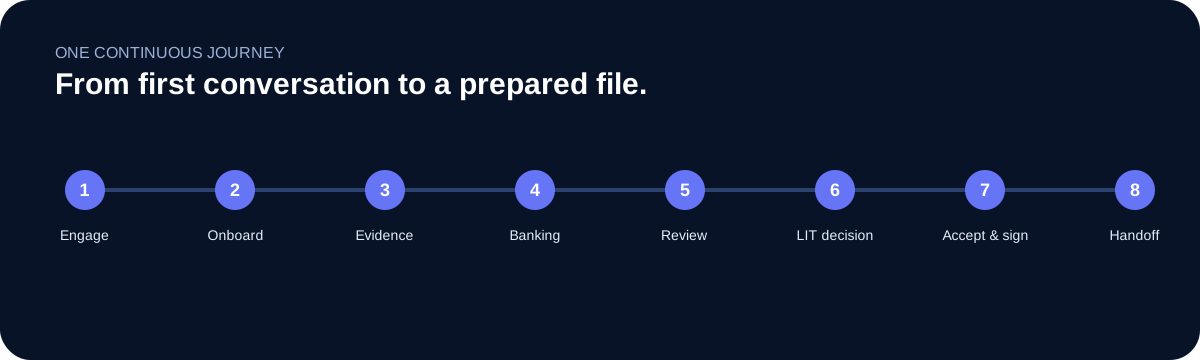
The website is backed by the same end-to-end debtor flow we use in the flagship presentation — not generic mock-ups.
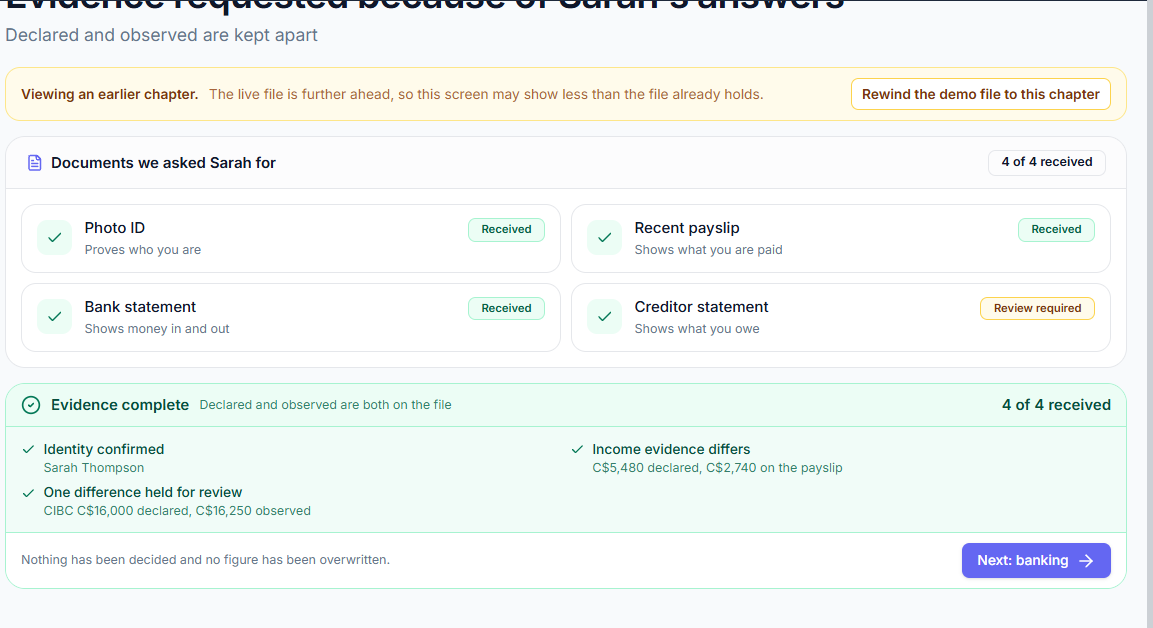
Uploads stay private. FastDox extracts observations, keeps them separate from declared values and routes differences for review.
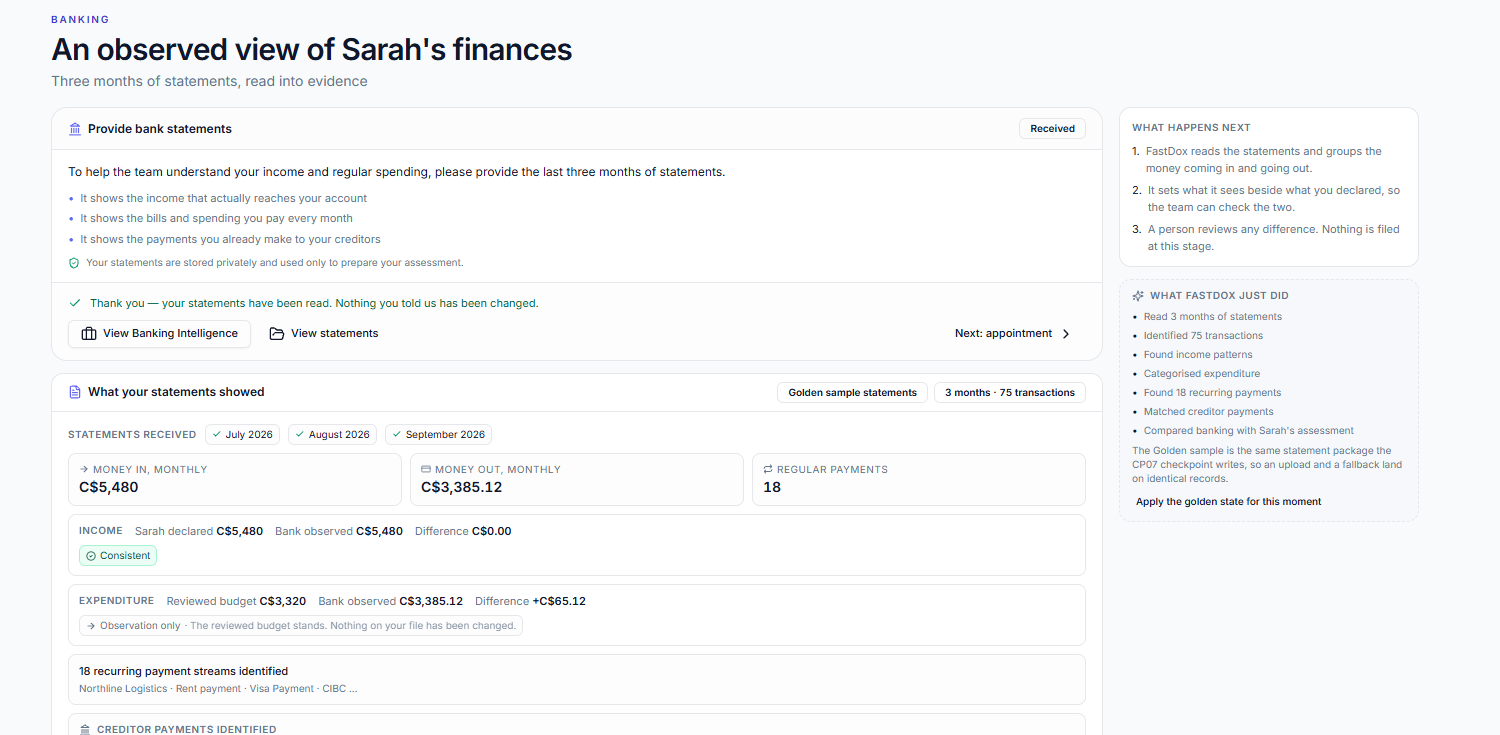
Observed income, expenditure, recurring payments and creditor patterns sit alongside — not on top of — the reviewed assessment.
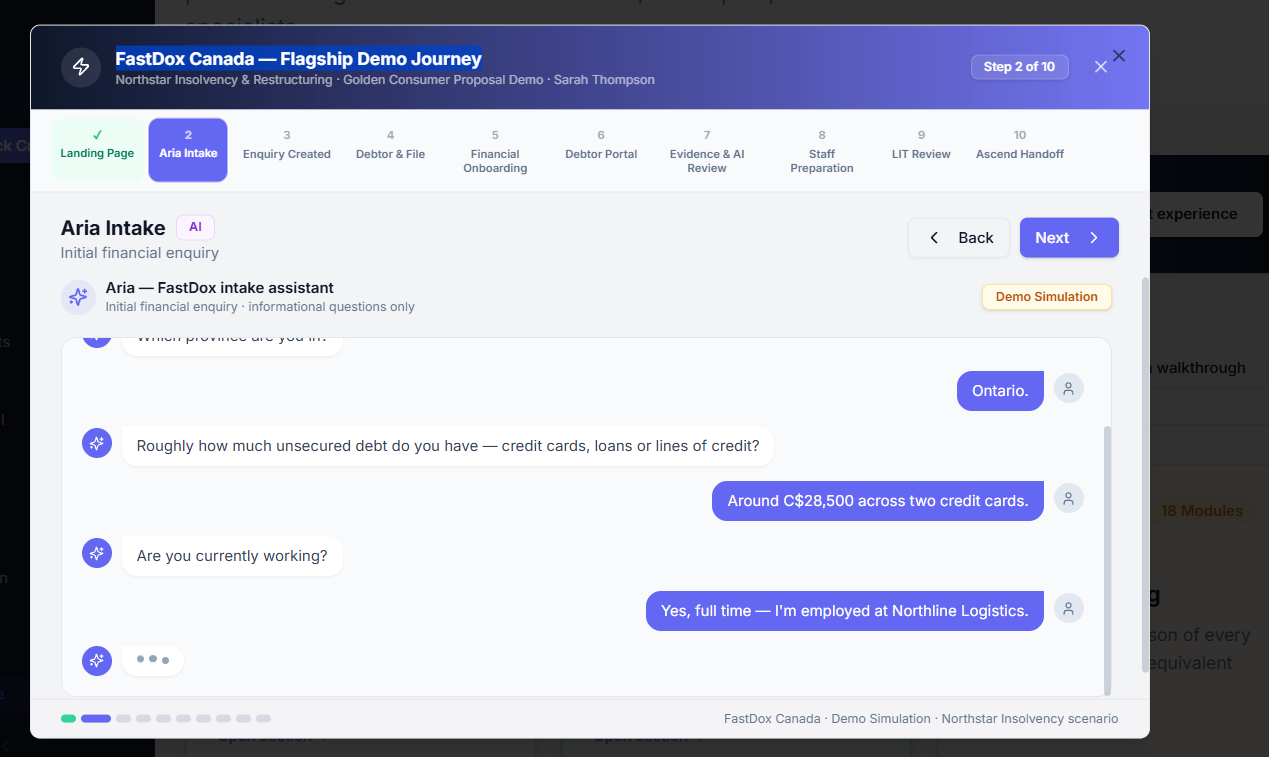
AI engagement, adaptive questions, uploads, appointments and signing all feed the same File.
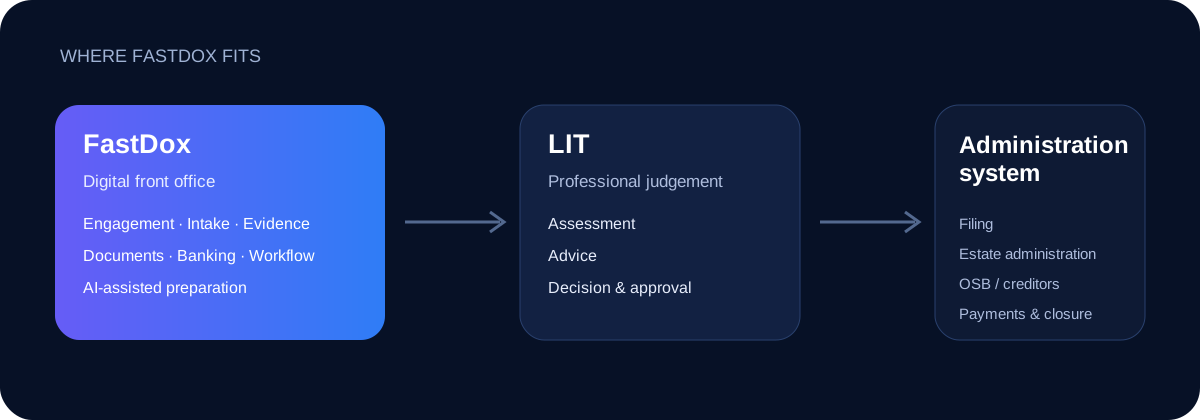
FastDox is designed to modernise engagement, intake, evidence and preparation — not force a firm to rip out its insolvency administration stack.
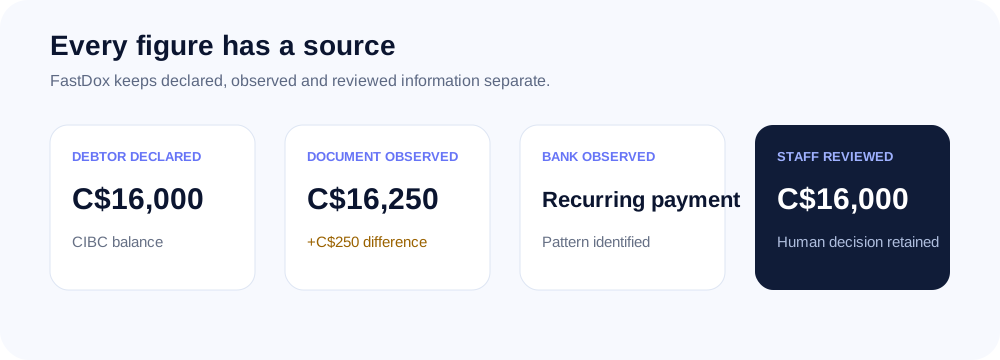
FastDox does not silently replace what a debtor told you when evidence differs. It preserves the source, surfaces the discrepancy and keeps the authoritative review explicit.
Forms, portal tasks, appointments and signatures that respond to the debtor.
Private uploads, classification, extraction and evidence comparison.
Observed income, expenditure, recurring streams and creditor payments.
Grounded file summaries, financial comparison and review-ready outputs.
Tasks, reminders, queues, exceptions and approval boundaries.
Verification steps, audit history and role-aware human review.
APIs and handoff patterns that work with your existing systems.
Private document handling, permissions and auditable operating controls.
In 2025, Canada recorded 140,457 consumer insolvencies and 78.4% were proposals. Firms handling that volume need a better way to prepare files without adding proportionate administrative effort.
Source: Office of the Superintendent of Bankruptcy, Insolvency Statistics in Canada — 2025.
We’ll tailor the walkthrough around your intake, review process and downstream administration system.